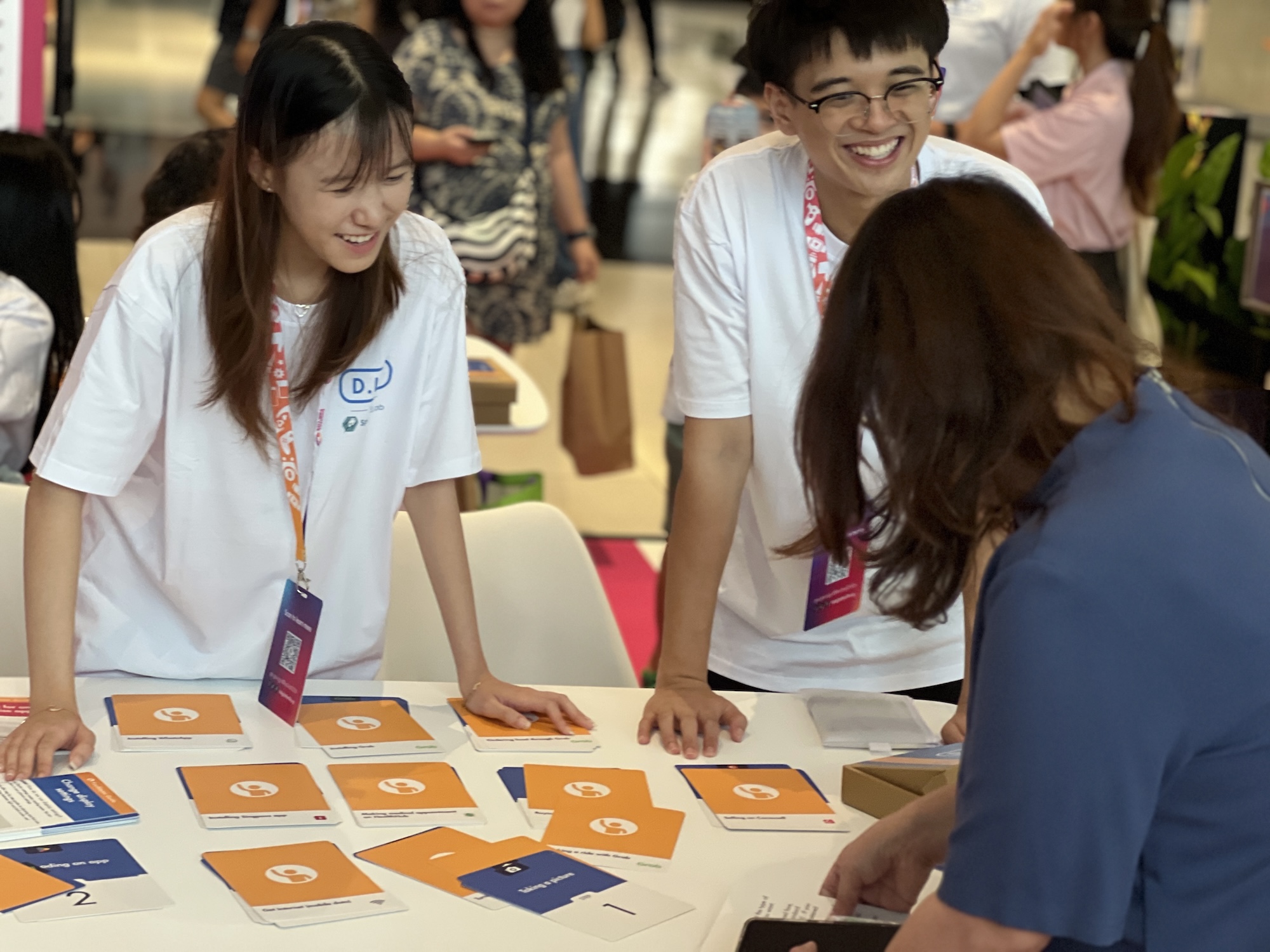
Shahmi Mohamad and Bovy Wong, 18-year-old students from the Institute of Technical Education, were among the D.Lit Facilitators at the Digital for Life Festival 2026 on 24th October.
The festival is an annual event designed to help people of all ages build digital literacy, try emerging technologies and learn the skills to be safe in the online space. It is organised by Singapore’s government agency, the Infocomm Media Development Authority (IMDA).
More than 130 community partners, and public and private partners came together over the weekend of 24th-25th October for the festival, held at the atrium level of the massive VivoCity mall at Harbourfront, just a short distance across the water from Sentosa island.
SpudnikLab was a festival partner, with a booth set up for individual facilitation for seniors in need of help navigating the tech of their mobile devices. A special D.Lit touch screen game was also designed for the Digital for Life Festival, which encouraged visitors to touch the virtual cards on the game screen in the correct order to learn steps in the right order to achieve digital skills navigating a mobile phone or phone app.

Shahmi, who has been a D.Lit Facilitator for about two months, decided to sign up for this volunteer role when he heard about it through the youth leadership programme he’s enrolled with at River Valley Irregulars.
“I always love to help out my elders as we all have our grandpas and grandmas and they are not too sure how to use their phones and their mobile devices.
So I was thinking, I want to challenge myself and also learn more about using phones and teaching others about using the phones.. and be more confident in my own abilities.”
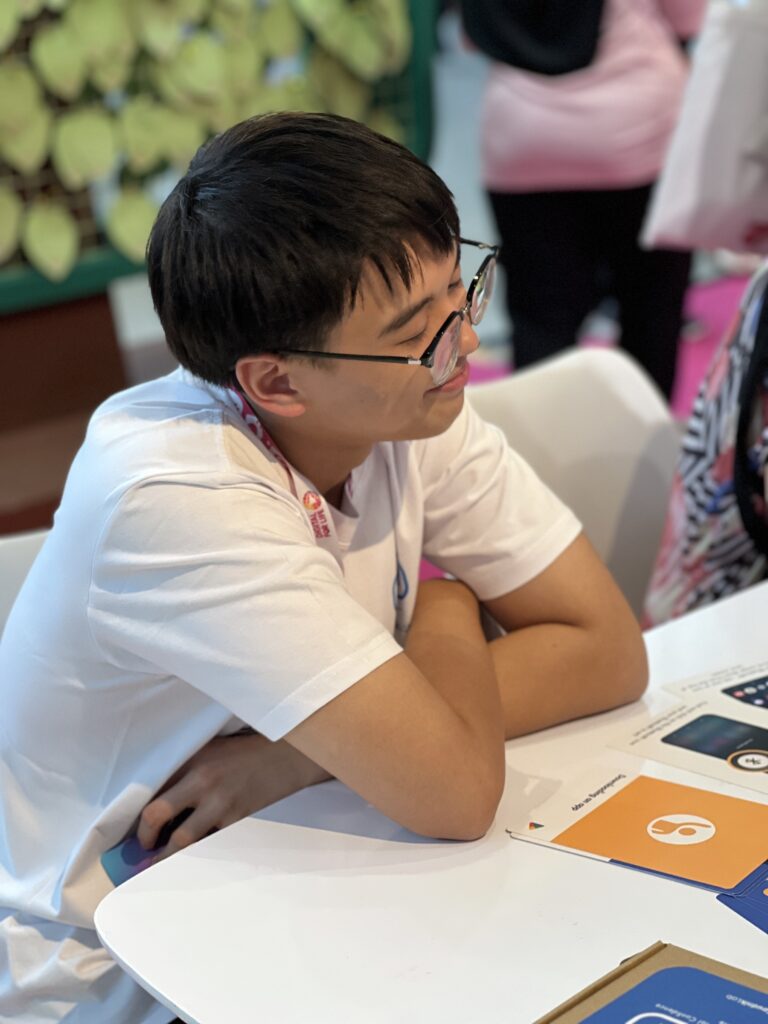
The learning doesn’t just happen one way. One of the aspects of this volunteer role Shahmi really enjoys is hearing from the seniors about their life experiences, and how life was in the past, and how it’s different now.
“I learned a lot of life lessons as well,” he says. “One of the life lessons was that when we are young, we should just use the time to really spend time with your friends and family members as much as you can, because when you get older, you don’t really have that time left. You only realise then that time is actually valuable— very, very valuable, and that we all don’t live very long as well. Yeah, time is very short.”
For Bovy, it was her first day on the job as a D.Lit Facilitator. However, it was hardly her first time being a volunteer and working with older people. She’d signed up for various volunteer activities at homes for seniors previously through school, such as art and craft activities and teaching, so she handled her first foray into D.Lit territory with ease and good spirit.

Says Bovy, “I think they [seniors] are very fun people to interact with, but I typically joined this program and this volunteering because of my grandparents. They are very bad with technology because they don’t use mobile phones and everything, but because of the fast-paced environment and everything consists of technology where you need to know some common technology to interact, call your parents, your son, your granddaughters, that’s why I feel it’s very important to help them learn how to use this technology.”
Shahmi and Bovy were kept constantly busy with a stream of elders who approached them to ask about using their mobile phones or solving niggly tech problems they’d been having. In between the troubleshooting and guidance, gentle and humorous conversations often flowed between the D.Lit Facilitators and the seniors they were tending to.

For Bovy, the visual nature of the cards in the D.Lit toolkit was instrumental in helping the seniors understand the step-by-step processes she was describing, from what many of us would consider common knowledge, like how to turn on wifi and data, to more challenging processes like navigating the Carousell app to buy or sell items.
“I see that they [the D.Lit cards] actually teach them through step by step, and it’s visual because for my own personal experience,” she says, “when I tell them what to press, they might not understand. They are like, ‘What is that thing? What camera?’ They know the actual [physical real life] camera but they don’t know the in-app camera, or how do they use it, although it might be very simple to like, teenagers or adults, but might not be very common for them.”
As the session was drawing to a close—it ran from 4pm–6pm—we asked Bovy how her first day volunteering as a D.Lit Facilitator had been so far.
“I think it’s very interesting because there are actually people who are very, very interested. And they actually ask me, ‘Oh, this is actually a good approach because they can visualise what the icon looks like, because they actually tell me they have trouble reading letters and wording, so they don’t understand.”
Learn more about D.Lit or sign up for a D.Lit workshop (it’s free!) at https://dlit.spudniklab.com/